Berry Galette, a Kidney-Friendly Dessert from Frozen Berries

Nutrition Snapshot

  • One wedge carries 58 mg of potassium and 27 mg of phosphorus, which is low for any fruit dessert.
  • Two cups of berries spread across six wedges, and berries run lower in potassium than most fruit.
  • A wedge has 27 grams of carbohydrate and 8 grams of fat, so count it as the meal’s starch.

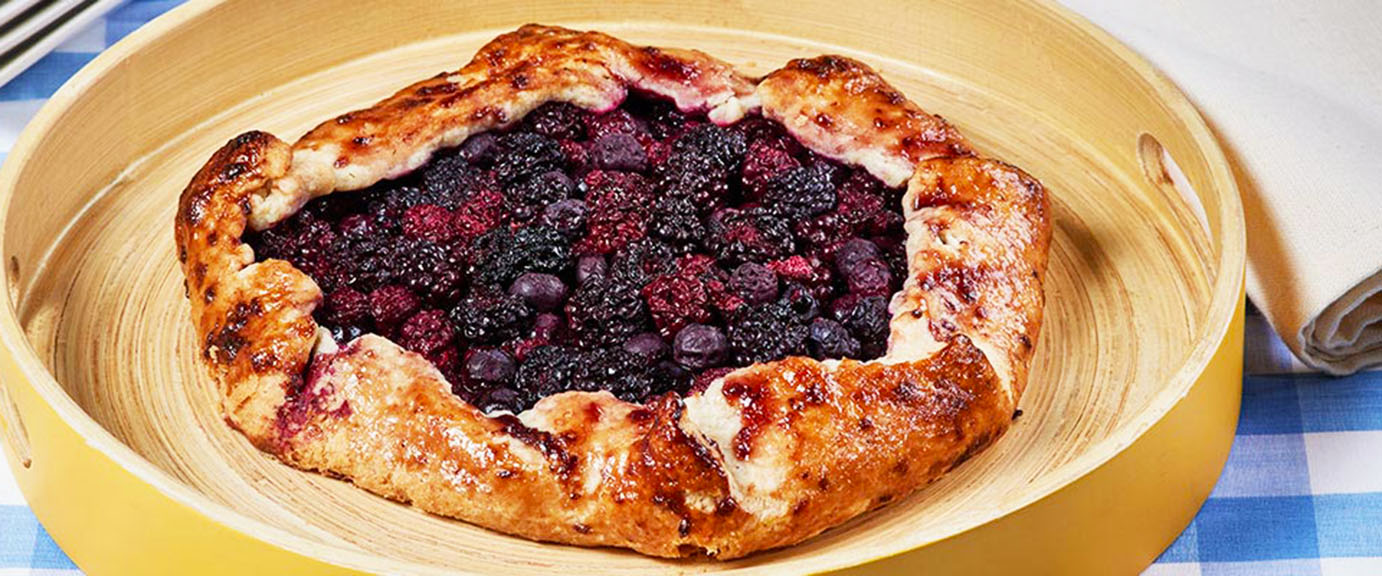
A galette is a pie without the pan. You roll one crust flat, pile fruit in the middle, fold the edge over the outside of the fruit, and bake it on a sheet. The shape is forgiving, which is the point of it.

Plan on about 15 minutes of hands-on work and 30 minutes in the oven, plus half an hour at the start to thaw the dough and the berries.

Berries Keep the Potassium Low in a Fruit Dessert

Why Potassium and Phosphorus Get a Limit

Healthy kidneys pass extra potassium and phosphorus into the urine. When kidney function drops, both build up in the blood. Potassium at a high level disturbs the heart’s rhythm. Phosphorus at a high level pulls calcium out of bone and deposits it in the walls of blood vessels. That is why a kidney care plan sets a daily ceiling on both.

Dessert is the hardest course to fit under those ceilings. Dairy, chocolate, and nuts are the three highest-phosphorus ingredients in most sweets, and bananas, dried fruit, and melon carry the potassium. This galette uses none of them.

Berries Run Lower in Potassium Than Most Fruit

A cup of raw blueberries has about 114 mg of potassium. A medium banana has more than three times that. Strawberries, blackberries, and raspberries all sit in the low-to-middle range for fruit. Two cups of mixed berries divided across six wedges is what holds this galette to 58 mg a wedge.

The Plain White Crust Keeps the Phosphorus Down

Milling strips the bran and the germ from wheat, and that is where most of the phosphorus and potassium in the grain sit. A refined crust therefore contributes very little of either. A whole wheat crust would raise both. This is one of the few places in nutrition where the refined choice is the one that fits the plan.

Read the Crust Label for Added Phosphate

Phosphorus added to a food as an additive is absorbed almost completely. The phosphorus already built into a plant food is absorbed at a much lower rate. Nutrient databases report the two as a single number (Kalantar-Zadeh et al., Clinical Journal of the American Society of Nephrology, 2010, PMID 20093346).

The 27 mg on the recipe card comes from a database. Turn the crust package over and read the ingredient list for any word containing phos. A crust without one keeps the real figure close to the calculated one.

What’s in a Serving

A serving is one wedge, one sixth of the galette. By weight it is roughly equal parts fruit and crust. The fruit supplies the fiber, the color, and a small amount of vitamin C. The crust supplies the fat and nearly all of the sodium.

The sugar is split in two. Two tablespoons go into the berries before baking and a half tablespoon goes over the top at the end. The berries bring their own sugar as well. The recipe card below has the exact figures.

What to Buy

Frozen Mixed Berries

Buy a plain bag with berries and nothing else on the ingredient list. Some mixes are sweetened or frozen in syrup, which adds sugar on top of what the recipe already calls for. Frozen berries are picked ripe and hold their shape better than out-of-season fresh ones. Thaw them in a bowl and pour off the liquid that collects, or that liquid runs out through the crust in the oven.

The Pie Crust

Use an unformed crust, meaning one sold rolled or flat rather than pressed into a foil pan. A pressed shell cannot be folded over the fruit. Read the ingredient list twice, once for added phosphate and once for the sodium figure, since the crust accounts for nearly all of both in this recipe.

Buy organic (to avoid glyphosate), since wheat is one of the crops often sprayed to dry the field before harvest, and organic growing does not allow it.

The Sugar and the Jam

Any granulated sugar works here. One tablespoon of blackberry jam goes on the folded edge and turns to a glaze in the oven, which is what gives the rim its shine. Any dark berry jam or preserve substitutes for it.

Who This Fits and Who Should Watch the Portion

Who It Fits

This suits anyone eating to a potassium and phosphorus limit, which usually means reduced kidney function. The numbers that matter are the ones your kidney team set for you, and one wedge fits inside most of them.

It also suits anyone who wants a fruit dessert with no dairy, no chocolate, and no nuts, whether the reason is a kidney limit or an allergy.

Go Easy If

Carbohydrate is the honest limit here. One wedge has 27 grams, close to what two slices of bread carry, and 8 grams of fat comes with it. Anyone counting carbohydrate should plan the wedge into the meal rather than adding it on the end.

One wedge also has 118 mg of sodium, and almost all of it comes from the crust. Crusts vary more than most people expect, and a common supermarket refrigerated crust would push a wedge closer to 175 mg. Read the crust label, since that is where the real number for your galette comes from.

The crust is wheat, so the recipe contains gluten as written. A rolled gluten-free crust works in its place, and the same label check applies to it.

How to Make It Your Own

Single-fruit versions work well. Two cups of frozen blueberries alone give the lowest potassium of any berry combination. Thin-sliced apple also folds into a galette and stays low in potassium, though it needs a few extra minutes in the oven to soften. A half teaspoon of cinnamon or the grated zest of a lemon changes the flavor without changing the figures.

Swaps Recap

  • Lower sodium: compare crust labels and pick the one with the least sodium a serving, since the crust accounts for nearly all of it.
  • Lower phosphorus: choose a crust whose ingredient list has no word containing phos.
  • Lower sugar: allulose measures like sugar by volume and browns faster, so watch the top over the last five minutes. A monk fruit blend sold at one to one also works. Follow the package, since monk fruit on its own is far sweeter than sugar. Both are lower in sugar and gentler on blood sugar.
  • Gluten free: use a rolled gluten-free pie crust in place of the wheat crust.
  • Dairy free: crusts vary, so read the label. One made with oil or shortening rather than butter keeps this dairy free.
  • Lower potassium still: use two cups of frozen blueberries in place of the mixed berries.

Storage, Make-Ahead, and Serving

The crust is crispest the day it is baked, because the fruit softens it from underneath overnight. Cover it loosely and keep it at room temperature for a day, or refrigerate it up to three days. Reheat a wedge at 350 degrees for eight to ten minutes to bring the crust back.

To get ahead, thaw the berries and drain them the night before and keep the drained fruit covered in the refrigerator. The dough rolls out straight from the refrigerator. Assembly takes about ten minutes once both are ready.

A free-form berry tart made from one rolled pie crust and two cups of frozen berries. The berries and the plain crust hold the potassium and phosphorus low for a fruit dessert.
Course dessert
Cuisine French
Keyword berry galette, frozen berries, kidney friendly dessert, low potassium dessert, rustic fruit tart
Prep Time 15 minutes
Cook Time 30 minutes
Total Time 45 minutes
Servings 6 servings
Calories 184kcal

Equipment

  • Rolling Pin
  • baking sheet
  • Medium Bowl
  • Microwave
  • Pastry Brush

Ingredients

  • 1 organic pie crust refrigerated or frozen, unformed
  • 2 cups mixed berries frozen
  • 2 1/2 tablespoons sugar granulated
  • 1 tablespoon blackberry jam

Instructions

  • Heat the oven to 425 F.
  • Thaw the pie dough and the frozen berries.
  • Roll the pie dough into a 12 inch circle.
  • Coat a baking sheet lightly with cooking spray.
  • Place the rolled dough on the baking sheet.
  • Combine the thawed berries and 2 tablespoons of the sugar in a medium bowl.
  • Arrange the berry mixture in the center of the dough, leaving a 2 to 3 inch border.
  • Fold the edges of the dough in toward the center.
  • Press the folds gently to seal. The dough covers the berries only partway.
  • Melt the blackberry jam in the microwave, 10 to 20 seconds.
  • Brush the folded edges of the dough with the melted jam.
  • Bake 10 minutes at 425 F.
  • Reduce the oven to 350 F.
  • Bake 20 minutes longer.
  • Remove the galette from the oven.
  • Sprinkle the remaining 1/2 tablespoon of sugar over the top.
  • Cut the galette into 6 wedges, as you would a pie.
  • Serve warm or at room temperature.

Notes

Serving size is one wedge, one sixth of the galette. One 12 inch galette cuts into 6 wedges.
Thawing the pie dough and the berries adds about 30 minutes of hands-off time. The prep and cook times cover only the hands-on work.
Thaw the berries in a bowl and pour off the liquid that collects before they go on the dough. Extra liquid runs out through the crust while it bakes.
Buy a plain bag of frozen berries with no added sugar and no syrup.
Use an unformed crust, the kind sold rolled or flat. A crust already pressed into a foil pan cannot be folded over the fruit.
Look for an organic pie crust. Wheat is often treated with glyphosate before harvest to dry the field down, and organic wheat is grown without it.
Lower sodium: nearly all the sodium here comes from the pie crust. Compare crust labels and choose the one with the least sodium a serving.
Lower phosphorus: read the crust ingredient list for any word containing phos. Added phosphate is absorbed far more completely than the phosphorus already in flour, and a calculated figure does not separate the two.
Lower sugar: allulose measures like sugar by volume and browns faster, so watch the top over the last 5 minutes. A monk fruit blend sold at one to one also works. Follow the package, since monk fruit on its own is far sweeter than sugar. Both are lower in sugar and gentler on blood sugar.
Gluten: the recipe contains wheat as written. A rolled gluten-free pie crust works in its place.
Dairy: crusts vary. One made with oil or shortening rather than butter keeps this dairy free.
Nut free and egg free as written. Crust labels vary, so read yours.
Storage: the crust is crispest the day it is baked. Cover loosely and keep at room temperature 1 day, or refrigerate up to 3 days. Reheat a wedge at 350 F for 8 to 10 minutes.
Make ahead: thaw and drain the berries the night before and keep them covered in the refrigerator. Assembly takes about 10 minutes once the dough and the fruit are ready.

Nutrition

Calories: 184kcal | Carbohydrates: 27g | Protein: 2g | Fat: 8g | Saturated Fat: 2g | Sodium: 118mg | Potassium: 58mg | Fiber: 2g | Sugar: 11g | Calcium: 10mg | Iron: 1mg | Magnesium: 7mg | Phosphorus: 27mg | Choline: 3mg

Berries and a Plain Crust Make a Dessert That Fits a Kidney Plan

Dessert is where a potassium and phosphorus limit usually costs people something, because dairy, chocolate, and nuts appear in almost every sweet. Fruit and a plain wheat crust hold one wedge of this galette to 58 mg of potassium and 27 mg of phosphorus. That is a real dessert inside the numbers.

Serve one wedge, warm, and count its 27 grams of carbohydrate as part of the meal rather than an extra.

Serve It With

A wedge lands best after a low-sodium meal, since most of the day’s sodium is usually spent by the time dessert arrives. Lemon Dill Chicken Salad for a Low-Sodium Cold Lunch and a wedge of this galette make a full plate that stays inside a kidney-friendly pattern.

For another dessert built to the same limits, see Low Phosphorus Fudge.

Related Posts