Jicama and Carrot Salad for a Low-Potassium Crunch

Nutrition Snapshot

  • A serving carries 3 grams of fiber for 75 calories, with 130 mg of potassium and 15 mg of phosphorus.
  • That mineral profile suits a kidney eating pattern that limits both potassium and phosphorus.
  • The tablespoon of honey adds about a teaspoon of sugar a serving, and two teaspoons sweetens the dressing about as well.

Fifteen minutes and a box grater is the whole method here. Nothing needs heat, and nothing needs to sit before you eat it.

The reason to make it is narrower than that. If your kidney care plan puts a ceiling on potassium, the crunchy raw vegetables left to you are a short list: cucumber, cabbage, celery, iceberg. Fiber is the first thing to go when that list shrinks, because the vegetables highest in fiber are mostly the ones highest in potassium too. Jicama sits outside that trade.

Jicama Gives You Fiber Without the Potassium

Jicama Stores Its Carbohydrate as Inulin

Most root vegetables store energy as starch. Jicama stores much of its carbohydrate as inulin instead, a chain of fructose units linked in a way human digestive enzymes cannot open. That chemistry is why a raw slice stays crisp and faintly sweet where raw potato turns chalky in your mouth.

Inulin therefore reaches the colon whole, and the bacteria living there ferment it. That is what makes inulin count as fiber on a label, and as food for your gut bacteria in practice.

Fiber Is the Hard Part of a Potassium Limit

Slow digestion is common on a potassium-restricted eating pattern, and the reason is arithmetic rather than willpower. Beans, potatoes, winter squash, greens, and dried fruit carry the most fiber per bite of anything in the produce aisle, and every one of them is also high in potassium. Cutting them back cuts fiber at the same time.

This bowl is three quarters jicama by volume, and the whole batch still comes to about 520 mg of potassium. That is the 130 mg a serving the card reports, alongside 3 grams of fiber.

Chicory and jicama supply the same kind of inulin-type fiber. Eating it regularly raises Bifidobacterium in the colon and improves bowel function, at daily amounts between 3 and 20 grams (Nagy et al., Crit Rev Food Sci Nutr, 2023, PMID 35833477).

One bowl of this salad is a start on that range. So keep a jicama in the crisper and cut it into more than one meal a week.

The Sodium Is Effectively Zero

A serving carries 12 mg of sodium. The recipe calls for no salt at all, and lime juice with cilantro carries the flavor instead.

That matters twice over on a kidney eating pattern. Sodium drives thirst, and thirst is the hard part of a fluid limit. A side that adds essentially none of it leaves room in the day’s total for something that needs it.

What’s in a Serving

A serving is a generous half cup, one fourth of the bowl. Most of it is grated jicama, with about a third as much carrot for color and sweetness. A few tablespoons of dressing coat the whole batch, so each serving picks up roughly a teaspoon of it.

It reads as a side rather than a meal. Two servings alongside a piece of fish is a reasonable dinner portion, and every figure on the card doubles when you eat two.

What to Buy

Jicama

Pick one that feels heavy for its size, with dry unbroken tan skin. Soft or damp patches mean it has sat in storage too long, and the flesh behind them turns woody. A medium jicama weighs about a pound, which is well past the 1 1/2 cups this recipe needs.

The skin is tough and papery, and a vegetable peeler takes it off faster than a paring knife. Peel down to clean white flesh with no tan streaks left behind, because the fibrous layer just under the skin stays stringy however fine you grate it.

Carrots

Whole carrots grate better than the bagged matchsticks, which are cut too thick to take up a thin dressing. Half a cup grated is one medium carrot.

Cilantro and Lime

Use the leaves and the thin upper stems, and leave the thick lower stems out, since they stay tough in a raw salad. Fresh lime juice is worth squeezing here, because bottled juice tastes flat against only five other ingredients.

Who This Fits and Who Should Watch the Portion

It Fits a Tight Renal Budget

At 130 mg of potassium and 15 mg of phosphorus a serving, this is one of the few raw vegetable sides that supplies real fiber inside a tight renal budget. It suits a low-sodium pattern at the same time.

Check those figures against the targets your kidney care team set for you. Targets vary by stage, and by whether you are on dialysis.

Start Small If Fermentable Fiber Gives You Trouble

Inulin is a fructan, which puts jicama on the high-FODMAP list. Someone managing IBS should start with a few tablespoons and work up from there. The same fermentation that feeds your gut bacteria produces gas along the way.

The Honey Is the One Thing to Reconsider for Blood Sugar

A tablespoon of honey across four servings comes to roughly a teaspoon of added sugar each, about a third of the 11 grams of carbohydrate the card reports. Two teaspoons of honey sweetens the dressing about as well. The swaps below cover the rest.

How to Make It Your Own

Heat suits this salad. A minced half jalapeno or a quarter teaspoon of chile powder in the dressing turns it toward the jicama with lime and chile that street vendors in Mexico sell by the cup.

Toasted pumpkin seeds add crunch and a little protein, though they also add phosphorus, so a tablespoon is the amount to stop at on a renal pattern. A grated Granny Smith apple in place of the carrot turns the whole thing tart and keeps every bit of the crunch.

Swaps Recap

  • Lower sugar: allulose or a monk fruit blend in place of the honey. Allulose measures close to sugar by volume and dissolves into lime juice the same way, so a raw dressing is where it behaves most like the original. Monk fruit is far sweeter than sugar and usually sold in a 1:1 blend, so follow the package.
  • Better fat: avocado oil or extra virgin olive oil in place of the canola oil, one for one.
  • Lower sodium: nothing to change. The recipe calls for no salt.
  • Vegan: maple syrup or allulose in place of the honey.
  • Dairy-free, gluten-free, and nut-free as written, with no swap needed.
  • More crunch, less sweetness: take the jicama up to 1 3/4 cups and drop the carrot to a quarter cup. Any change in the proportions changes the calculated figures, so the card has to be recalculated before you rely on them.

Storage, Make-Ahead, and Serving Ideas

Dressed, it holds about a day in a covered container in the refrigerator. The lime juice softens the grated jicama past that, and the crunch is most of the appeal.

To get further ahead, grate the jicama and carrot, keep them dry in a covered container for up to three days, and keep the dressing in a jar beside them. Toss the two together in the minute before you serve it. It goes anywhere a slaw would, so spoon it into fish tacos or pile it beside grilled chicken.

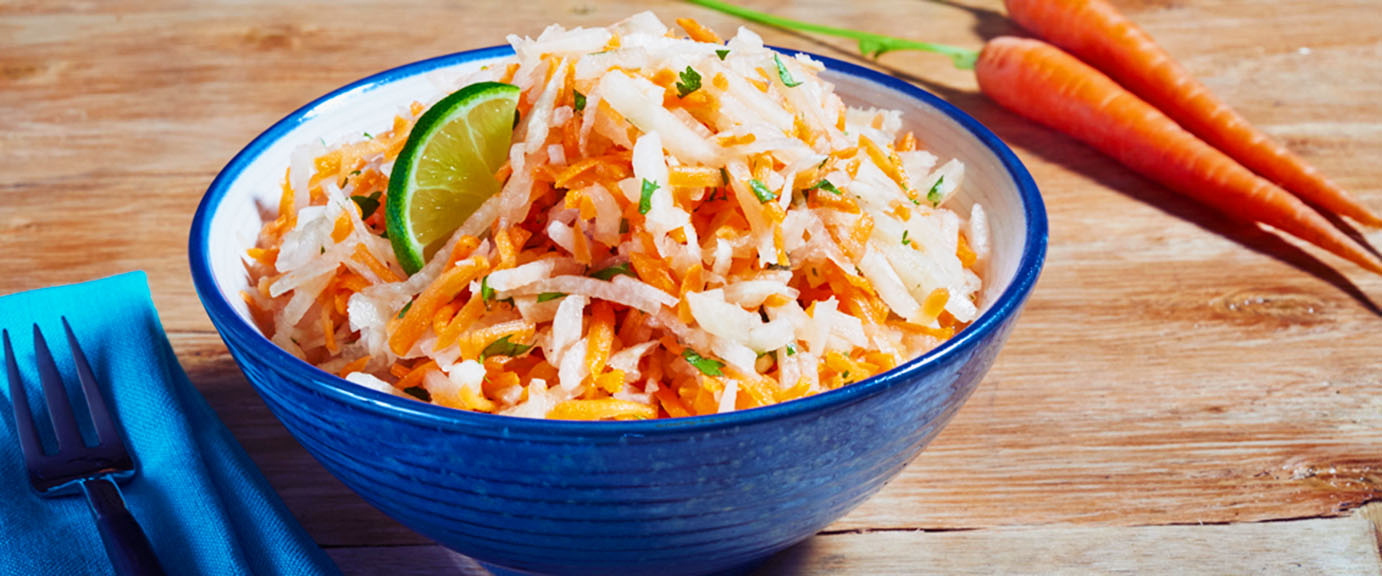
Grated jicama and carrot in a lime and honey dressing, ready in 15 minutes with no cooking. A serving carries 3 grams of fiber for 130 mg of potassium and 15 mg of phosphorus.
Course Salad
Cuisine Mexican
Keyword high fiber, jicama, kidney-friendly, low potassium, no cook
Prep Time 15 minutes
Total Time 15 minutes
Servings 4 servings
Calories 74kcal

Equipment

  • Vegetable Peeler
  • Box Grater
  • Chef’s Knife
  • Medium Bowl
  • Small Jar with Lid

Ingredients

  • 1/2 cup carrots grated
  • 1 1/2 cups jicama peeled and grated
  • 1 tablespoon cilantro chopped, fresh
  • 2 tablespoons lime juice fresh
  • 1 tablespoon canola oil
  • 1 tablespoon honey

Instructions

  • Grate the carrots and jicama.
  • Chop the cilantro.
  • Combine the carrots, jicama, and cilantro in a medium bowl.
  • Combine the lime juice, oil, and honey in a small jar or bowl.
  • Pour the dressing over the carrot mixture.
  • Toss to combine.

Notes

Serving size is a generous 1/2 cup, one fourth of the bowl. The recipe makes about 2 1/4 cups in total, so it gives 4 servings.
Jicama has a tough papery skin. Peel it with a vegetable peeler down to clean white flesh before grating, because the fibrous layer under the skin stays stringy however fine you grate it.
This recipe calls for no salt, so the calculated sodium figure of 12 mg a serving is the sodium in the vegetables and the lime juice alone.
Lower sugar: use allulose or a monk fruit blend in place of the honey. Allulose measures close to sugar by volume and dissolves into lime juice the same way, so a raw dressing is where it behaves most like the original. Monk fruit is far sweeter than sugar and usually sold in a 1:1 blend, so follow the package. Two teaspoons of honey instead of one tablespoon also sweetens the dressing about as well.
Better fat: use avocado oil or extra virgin olive oil in place of the canola oil, one for one.
Dairy-free, gluten-free, and nut-free as written, with no swap needed. Use maple syrup or allulose in place of the honey for a vegan version.
Make-ahead: grate the jicama and carrot and keep them dry in a covered container up to 3 days, with the dressing in a jar beside them. Toss the two together just before serving. Dressed, the salad holds about 1 day before the jicama softens.
Buying: pick a jicama that feels heavy for its size, with dry unbroken tan skin. Soft or damp patches mean the flesh behind them has turned woody.

Nutrition

Calories: 74kcal | Carbohydrates: 11g | Protein: 1g | Fat: 4g | Saturated Fat: 0.3g | Sodium: 13mg | Potassium: 136mg | Fiber: 3g | Sugar: 6g | Calcium: 13mg | Iron: 0.4mg | Magnesium: 9mg | Phosphorus: 16mg | Choline: 9mg

Takeaway

Jicama is the rare crunchy raw vegetable that gives you fiber inside a potassium limit. This salad puts 3 grams of it on the table for 130 mg of potassium and 15 mg of phosphorus. Cut the honey to two teaspoons and the added sugar drops to about half a teaspoon a serving. A generous half cup is one serving.

Serve It With

This belongs beside something plain and lean, since the lime and cilantro season both at once. Cod Fillet Tacos are the obvious partner, and a spoonful of this salad works as the slaw inside them. Easy Cilantro Lime Coleslaw is the cabbage version of the same idea, for a week when jicama is nowhere in the store.

For a renal pattern that also wants a dessert, Low Phosphorus Fudge is about 27 mg of phosphorus a square. More on the kinds of fiber and what each one does is in Fiber 101.

Related Posts